Genelec UNIO Personal Reference Monitoring System
Product Description
Bridge loudspeaker and headphone monitoring with the Genelec UNIO Personal Reference Monitoring system. A 9320A Reference Controller, factory-calibrated 8550A headphones and measurement microphone provide a coordinated monitoring workflow. The system combines hands-on control with Genelec calibration tools for reliable listening decisions.
Supplied Configuration
One complete UNIO Personal Reference Monitoring system.
9320A SAM Reference Controller, factory-calibrated 8550A Reference Headphones and measurement microphone.
Specifications
System components
| Reference Controller | 9320A |
|---|---|
| Reference Headphones | Factory-calibrated 8550A |
| Calibration | Measurement microphone; Genelec GLM calibration workflow |
9320A Reference Controller Specifications
9320A
SAM™ Reference Controller
Technical Specifications
Connectivity
• Genelec measurement microphone connector.
• Headphones output (6.3 mm stereo jack).
• Stereo analogue balanced line outputs (6.3 mm tip-ring-sleeve connectors).
• Stereo analogue balanced line inputs (6.3 mm tip-ring-sleeve connectors).
• XLR digital audio output, supports AES/EBU (AES3) format.
• XLR digital audio input, supports AES/EBU (AES3) format and SPDIF format when used with a separate 75 to 110 ohm impedance converter.
• GLM management network connection (bottom connector) and GLM network terminator connector needed for long networks (top connector).
• USB type C auxiliary power input for use when the computer USB output cannot supply sufficient power for 9320A.
• Kensington compatible anti-theft lock opening (top).
• USB type C computer interface, used for management, audio input, and power supply for 9320A.
The 9320 uses power from one USB connector at a time. When both connectors are connected, the PWR connector is used for power. The computer USB-C power input limits to 2.5 W input power (500mA input current). When the PWR connector is in used, the output power available to the headphone is
slightly higher; the benefit is +0 dB to 2.5 dB more output, depending on the load impedance. The PWR input connector is designed to work with a standard 5 V 1A USB power adapter.
Performance Summary
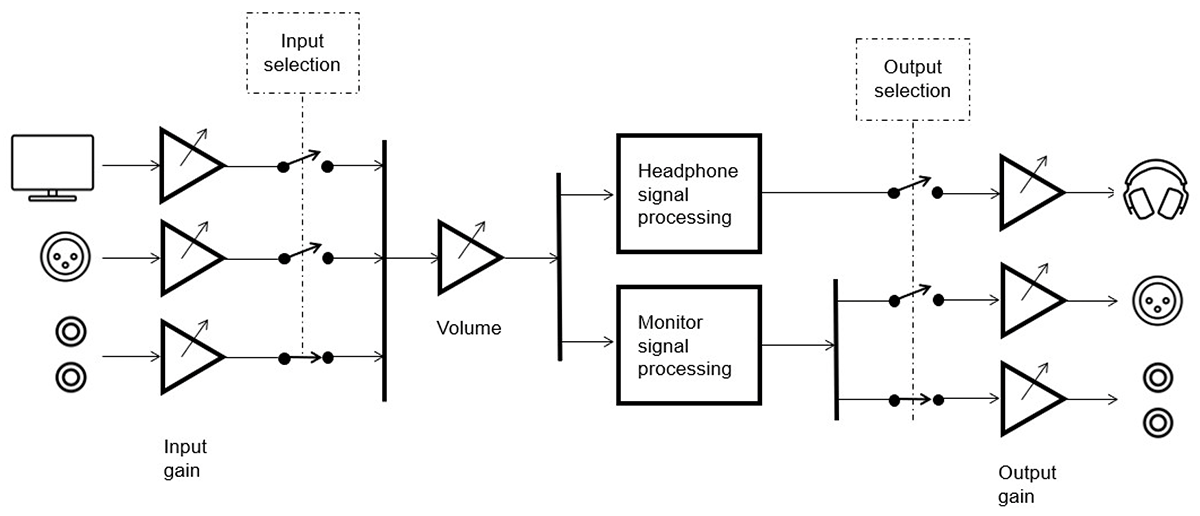
Mechanical and power
| Parameter | Unit | Value |
|---|---|---|
| Weight | kg (lbs) | 0.890 (2.0) |
| Height | mm (in) | 60 (2 3/8) |
| Width | mm (in) | 190 (7 1/2) |
| Depth | mm (in) | 139 (5 1/2) |
| Supply voltage, USB type C connector | VDC | 5 |
| Operating power consumption, no outputs driven | W | 1.5 |
| Operating power consumption, using computer connector USB-C | W | < 2.5 (typ. 2.25) |
| Operating power consumption, using PWR connector USB-C | W | < 3.5 |
| Sleep mode power consumption | W | 0.125 |
| Operating temperature | C (F) | 15 – 35 (60 – 95) |
| Operating humidity, noncondensing | % | 10 – 80 |
Typical system performance
| Parameter | Unit | AES/EBU input to headphone output | AES/EBU input to line output | Line input to line output | Line input to headphone output | Line input to AES/EBU output |
|---|---|---|---|---|---|---|
| Frequency response, – 3 dB point | kHz | 0 – 46 | 0 – 46 | 0.2 Hz – 46 | 0.2 Hz – 46 | 0.2 Hz – 46 |
| Frequency response flatness, measurement range 10Hz – 40 kHz | dB | ± 0.1 | ± 0.1 | ± 0.1 | ± 0.1 | ± 0.1 |
| Channel gain difference | dB | < 0.1 | < 0.1 | < 0.1 | < 0.1 | < 0.1 |
| Dynamic range (Lo Gain / Hi Gain) | dB | 126 (250-600Ω) | 126 | 121 / 118 | 121 / 118 | 123 / 121 |
| Noise (A weighted), measurement range 20 Hz – 20 kHz, (Vol. -0dBFS) (Lo Gain / Hi Gain) | μV | 3 / 3 | 5.5 / 7.5 | 5.5 / 7.5 | n.a. | n.a. |
| THD+N distortion and noise (Lo Gain), maximum volume setting, input signal -6 to 0 dBFS 1 kHz, measurement range 20 Hz - 20 kHz | % / dB | < 0.0004 / < –108 | < 0.0004 / < –108 | < 0.0005 / < –106 | < 0.0005 / < –106 | < 0.0004 / < –108 |
| THD+N distortion and noise (Hi Gain), maximum volume setting, input signal -6 to 0 dBFS 1 kHz, measurement range 20 Hz - 20 kHz | % / dB | n.a. | n.a. | < 0.0006 / -104 | < 0.0006 / -104 | < 0.0005 / -106 |
| Input to output latency | ms | 3.2 | 3.2 | 2.1 | 2.1 | 2.0 |
| Crosstalk 10kHz -10dBFS Load impedances (100 kΩ, 150 Ω, 32 Ω)* | dB | -120, -87, -74* | -120 | -120 | -120, -87, -74* | -120 |
| * When using small headphone loads, most of the crosstalk is caused by impedance of common ground of TRS connector. | ||||||
Typical output performance
| Parameter | Unit | Headphone output | Analog line output | AES/EBU output |
|---|---|---|---|---|
| Connector | 1/4 in TRS | 1/4 in TRS | XLR male | |
| Electrical interface | Split supply, ground referenced | Balanced | AES 3 | |
| Maximum output voltage | V RMS (dBu) | 6 (17.8) | 6 (17.8) | n.a. |
| V peak | 10.6 | 10.6 | n.a. | |
| V peak-to-peak | 21.3 | 21.3 | n.a. | |
| Output impedance | Ω (ohm) | 1.5 | 80 | 110 |
| Max output current | mA | 120 | n.a. | n.a. |
| Headphone maximum output power (Both left and right channels loaded. Power feed from the computer USB-C connector. In parenthesis when the PWR USB-C input is used for power.) | mW |
|
n.a. | n.a. |
| Frequency response (-3 dB point) | kHz | 0 – 46 | 0 – 46 | 0 – 46 |
| Frequency response flatness (range 10Hz – 40 kHz) | dB | ± 0.1 | ± 0.1 | ± 0.01 |
| Channel gain difference | dB | < 0.05 | < 0.05 | < 0.01 |
| Dynamic range | dB | 126 (Load 250-600Ω) | 126 | 138 |
| Noise A weighted (20-20 kHz) | uV | 3 | 3 | n.a. |
| Distortion and noise (250-600Ω) Input -6 to 0 dBFS 1 kHz, 20 Hz to 20 kHz measurement range. | % | < 0.0004 | < 0.0004 | n.a. |
| dB | < –108 | < –108 | n.a. |
Typical input performance
| Parameter | Unit | Analogue line input | USB input | AES/EBU input |
|---|---|---|---|---|
| Connector | mm (in) | 6.3 (1/4) TRS | USB-C | XLR female |
| Interface type, electrical | Balanced | USB 2.0 High Speed | AES 3 | |
| Maximum input voltage (Lo Gain) | dBu | 24 | n.a. | n.a. |
| Maximum input voltage (Hi Gain) | dBu | 12 | n.a. | n.a. |
| Input impedance, differential | Ω (ohm) | 6600 | n.a. | 110 |
| Frequency response, -3 dB | kHz | 0.2 Hz - 46 | 0 – 46 | 0 – 46 |
| Samplerates | kHz | n.a. | 44.1, 48, 88.2, 96, 176.4, 192 | 32 – 192 |
| Sample word length | bit | n.a. | 24 | 16 – 24 |
| Frequency response flatness 20 Hz - 40 kHz | dB | ± 0.05 | ± 0.01 | ± 0.01 |
| Channel gain difference | dB | < 0.05 | < 0.01 | < 0.01 |
| Dynamic range (A weighted) 20-20kHz (Lo Gain / Hi Gain) | dB | 123 / 121 | 138 (24 bit) | 138 (24 bit) |
| Equivalent input noise (A weighted) 20-20kHz (Lo Gain / Hi Gain) | μV | 9 / 3 | n.a. | n.a. |
| THD+N distortion and noise (Hi Gain), input signal -6 to 0 dBFS 1 kHz, measurement range 20 Hz - 20 kHz | % / dB | 0.0005 / –106 | n.a. | n.a. |
| Distortion and noise (Low Gain), input signal -6 to 0 dBFS 1 kHz, measurement range 20 Hz - 20 kHz | % / dB | 0.0004 / –108 | n.a. | n.a. |
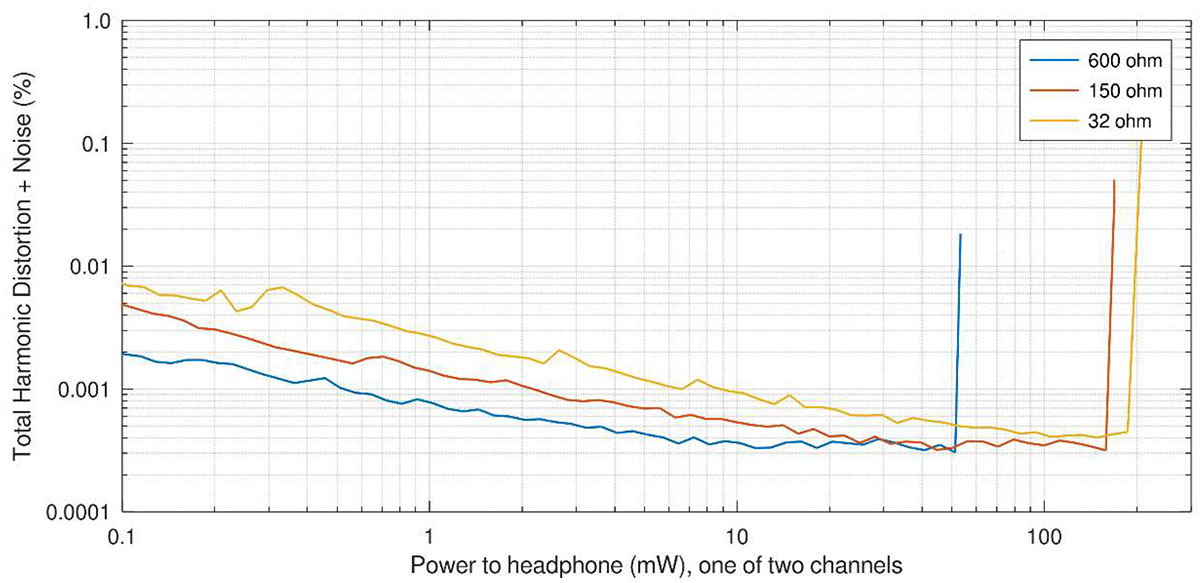
Typical total harmonic distortion + noise performance of the headphone output at various headphone imedances.
8550A Reference Headphones
| Design | Closed, circumaural; dynamic |
|---|---|
| Transducers | 40 mm, neodymium magnets |
| Frequency response | 15 Hz to 20 kHz |
| Short-term SPL with 9320A | 119 dB |
| Calibration | Factory-calibrated headphones matched with 9320A |
| Ear cushions | Leather and velvet |
| Cables | Straight and coiled |