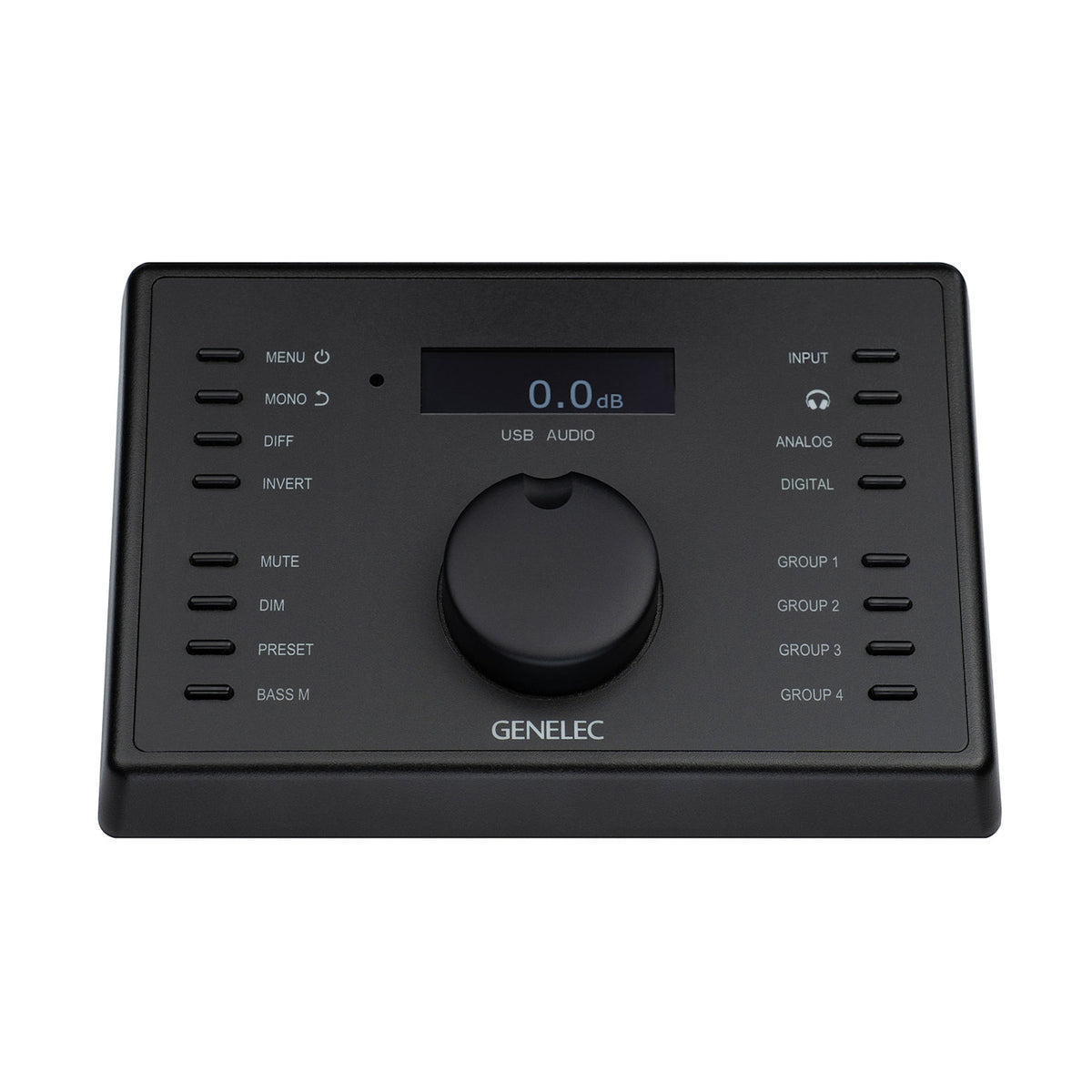
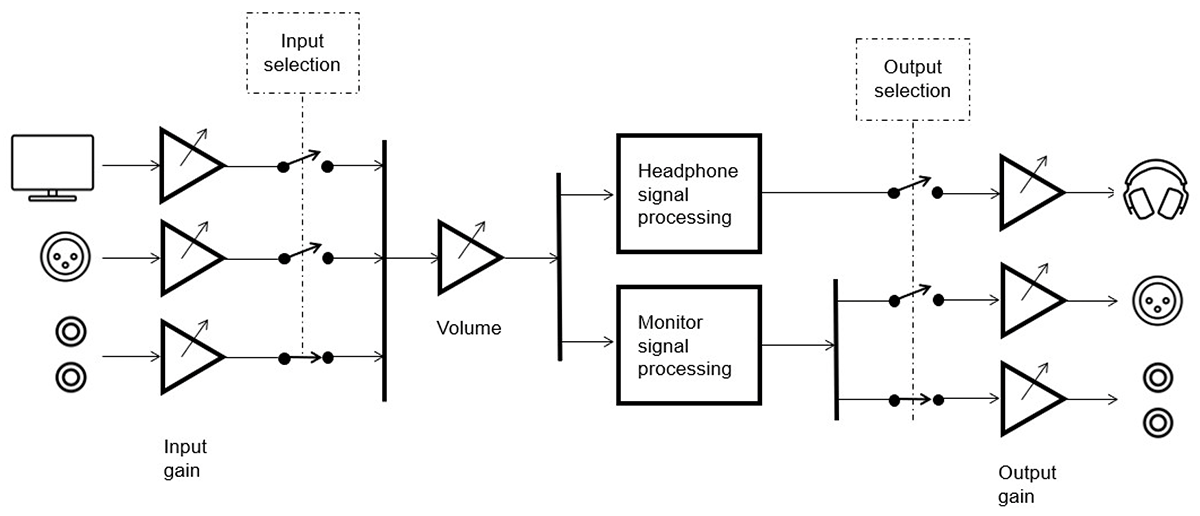
Bring loudspeaker and headphone monitoring under one compact desktop controller. The 9320A provides analogue, digital and USB connectivity, tactile level control and integration with Genelec GLM calibration. Its reference headphone output and monitoring tools support a consistent workflow between different listening systems.
One unit.
9320A
SAM™ Reference Controller
Technical Specifications
Connectivity
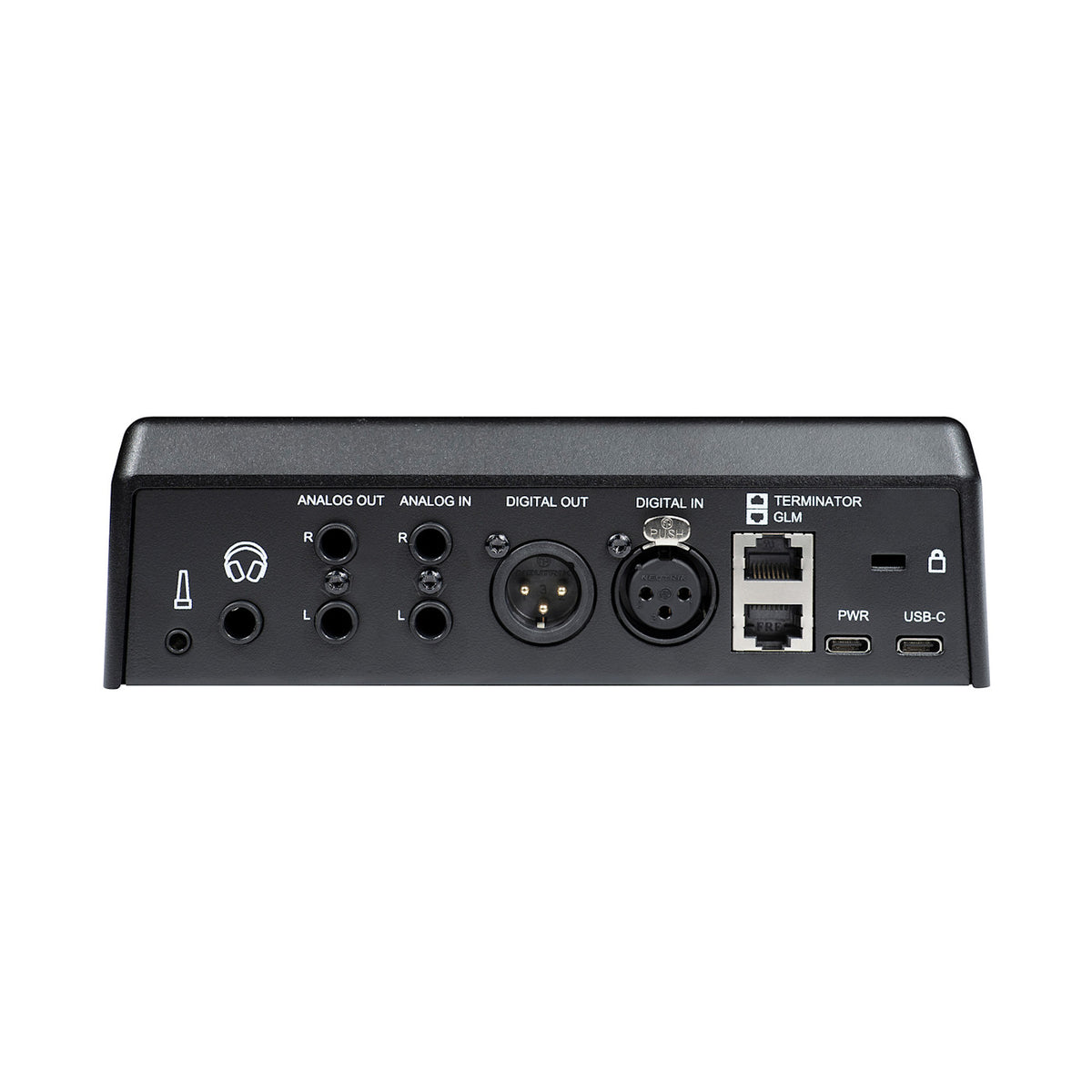
• Genelec measurement microphone connector.
• Headphones output (6.3 mm stereo jack).
• Stereo analogue balanced line outputs (6.3 mm tip-ring-sleeve connectors).
• Stereo analogue balanced line inputs (6.3 mm tip-ring-sleeve connectors).
• XLR digital audio output, supports AES/EBU (AES3) format.
• XLR digital audio input, supports AES/EBU (AES3) format and SPDIF format when used with a separate 75 to 110 ohm impedance converter.
• GLM management network connection (bottom connector) and GLM network terminator connector needed for long networks (top connector).
• USB type C auxiliary power input for use when the computer USB output cannot supply sufficient power for 9320A.
• Kensington compatible anti-theft lock opening (top).
• USB type C computer interface, used for management, audio input, and power supply for 9320A.
The 9320 uses power from one USB connector at a time. When both connectors are connected, the PWR connector is used for power. The computer USB-C power input limits to 2.5 W input power (500mA input current). When the PWR connector is in used, the output power available to the headphone is
slightly higher; the benefit is +0 dB to 2.5 dB more output, depending on the load impedance. The PWR input connector is designed to work with a standard 5 V 1A USB power adapter.
Performance Summary
Mechanical and power
| Parameter |
Unit |
Value |
| Weight |
kg (lbs) |
0.890 (2.0) |
| Height |
mm (in) |
60 (2 3/8) |
| Width |
mm (in) |
190 (7 1/2) |
| Depth |
mm (in) |
139 (5 1/2) |
| Supply voltage, USB type C connector |
VDC |
5 |
| Operating power consumption, no outputs driven |
W |
1.5 |
| Operating power consumption, using computer connector USB-C |
W |
< 2.5 (typ. 2.25) |
| Operating power consumption, using PWR connector USB-C |
W |
< 3.5 |
| Sleep mode power consumption |
W |
0.125 |
| Operating temperature |
C (F) |
15 – 35 (60 – 95) |
| Operating humidity, noncondensing |
% |
10 – 80 |
Typical system performance
| Parameter |
Unit |
AES/EBU input to headphone output |
AES/EBU input to line output |
Line input to line output |
Line input to headphone output |
Line input to AES/EBU output |
| Frequency response, – 3 dB point |
kHz |
0 – 46 |
0 – 46 |
0.2 Hz – 46 |
0.2 Hz – 46 |
0.2 Hz – 46 |
| Frequency response flatness, measurement range 10Hz – 40 kHz |
dB |
± 0.1 |
± 0.1 |
± 0.1 |
± 0.1 |
± 0.1 |
| Channel gain difference |
dB |
< 0.1 |
< 0.1 |
< 0.1 |
< 0.1 |
< 0.1 |
| Dynamic range (Lo Gain / Hi Gain) |
dB |
126
(250-600Ω) |
126 |
121 / 118 |
121 / 118 |
123 / 121 |
| Noise (A weighted), measurement range 20 Hz – 20 kHz, (Vol. -0dBFS) (Lo Gain / Hi Gain) |
μV |
3 / 3 |
5.5 / 7.5 |
5.5 / 7.5 |
n.a. |
n.a. |
| THD+N distortion and noise (Lo Gain), maximum volume setting, input signal -6 to 0 dBFS 1 kHz, measurement range 20 Hz - 20 kHz |
% / dB |
< 0.0004 / < –108 |
< 0.0004 / < –108 |
< 0.0005 / < –106 |
< 0.0005 / < –106 |
< 0.0004 / < –108 |
| THD+N distortion and noise (Hi Gain), maximum volume setting, input signal -6 to 0 dBFS 1 kHz, measurement range 20 Hz - 20 kHz |
% / dB |
n.a. |
n.a. |
< 0.0006 / -104 |
< 0.0006 / -104 |
< 0.0005 / -106 |
| Input to output latency |
ms |
3.2 |
3.2 |
2.1 |
2.1 |
2.0 |
| Crosstalk 10kHz -10dBFS Load impedances (100 kΩ, 150 Ω, 32 Ω)* |
dB |
-120, -87, -74* |
-120 |
-120 |
-120, -87, -74* |
-120 |
|
* When using small headphone loads, most of the crosstalk is caused by impedance of common ground of TRS connector.
|
Typical output performance
| Parameter |
Unit |
Headphone output |
Analog line output |
AES/EBU output |
| Connector |
|
1/4 in TRS |
1/4 in TRS |
XLR male |
| Electrical interface |
|
Split supply, ground referenced |
Balanced |
AES 3 |
| Maximum output voltage |
V RMS (dBu) |
6 (17.8) |
6 (17.8) |
n.a. |
|
V peak |
10.6 |
10.6 |
n.a. |
|
V peak-to-peak |
21.3 |
21.3 |
n.a. |
| Output impedance |
Ω (ohm) |
1.5 |
80 |
110 |
| Max output current |
mA |
120 |
n.a. |
n.a. |
| Headphone maximum output power (Both left and right channels loaded. Power feed from the computer USB-C connector. In parenthesis when the PWR USB-C input is used for power.) |
mW |
- 16 Ω: 90 (123)
- 32 Ω: 120 (211)
- 100 Ω: 123 (203)
- 150 Ω: 141 (173)
- 250 Ω: 100 (144)
- 600 Ω: 53 (53)
|
n.a. |
n.a. |
| Frequency response (-3 dB point) |
kHz |
0 – 46 |
0 – 46 |
0 – 46 |
| Frequency response flatness (range 10Hz – 40 kHz) |
dB |
± 0.1 |
± 0.1 |
± 0.01 |
| Channel gain difference |
dB |
< 0.05 |
< 0.05 |
< 0.01 |
| Dynamic range |
dB |
126 (Load 250-600Ω) |
126 |
138 |
| Noise A weighted (20-20 kHz) |
uV |
3 |
3 |
n.a. |
| Distortion and noise (250-600Ω) Input -6 to 0 dBFS 1 kHz, 20 Hz to 20 kHz measurement range. |
% |
< 0.0004 |
< 0.0004 |
n.a. |
|
dB |
< –108 |
< –108 |
n.a. |
Typical input performance
| Parameter |
Unit |
Analogue line input |
USB input |
AES/EBU input |
| Connector |
mm (in) |
6.3 (1/4) TRS |
USB-C |
XLR female |
| Interface type, electrical |
|
Balanced |
USB 2.0 High Speed |
AES 3 |
| Maximum input voltage (Lo Gain) |
dBu |
24 |
n.a. |
n.a. |
| Maximum input voltage (Hi Gain) |
dBu |
12 |
n.a. |
n.a. |
| Input impedance, differential |
Ω (ohm) |
6600 |
n.a. |
110 |
| Frequency response, -3 dB |
kHz |
0.2 Hz - 46 |
0 – 46 |
0 – 46 |
| Samplerates |
kHz |
n.a. |
44.1, 48, 88.2, 96, 176.4, 192 |
32 – 192 |
| Sample word length |
bit |
n.a. |
24 |
16 – 24 |
| Frequency response flatness 20 Hz - 40 kHz |
dB |
± 0.05 |
± 0.01 |
± 0.01 |
| Channel gain difference |
dB |
< 0.05 |
< 0.01 |
< 0.01 |
| Dynamic range (A weighted) 20-20kHz (Lo Gain / Hi Gain) |
dB |
123 / 121 |
138 (24 bit) |
138 (24 bit) |
| Equivalent input noise (A weighted) 20-20kHz (Lo Gain / Hi Gain) |
μV |
9 / 3 |
n.a. |
n.a. |
| THD+N distortion and noise (Hi Gain), input signal -6 to 0 dBFS 1 kHz, measurement range 20 Hz - 20 kHz |
% / dB |
0.0005 / –106 |
n.a. |
n.a. |
| Distortion and noise (Low Gain), input signal -6 to 0 dBFS 1 kHz, measurement range 20 Hz - 20 kHz |
% / dB |
0.0004 / –108 |
n.a. |
n.a. |
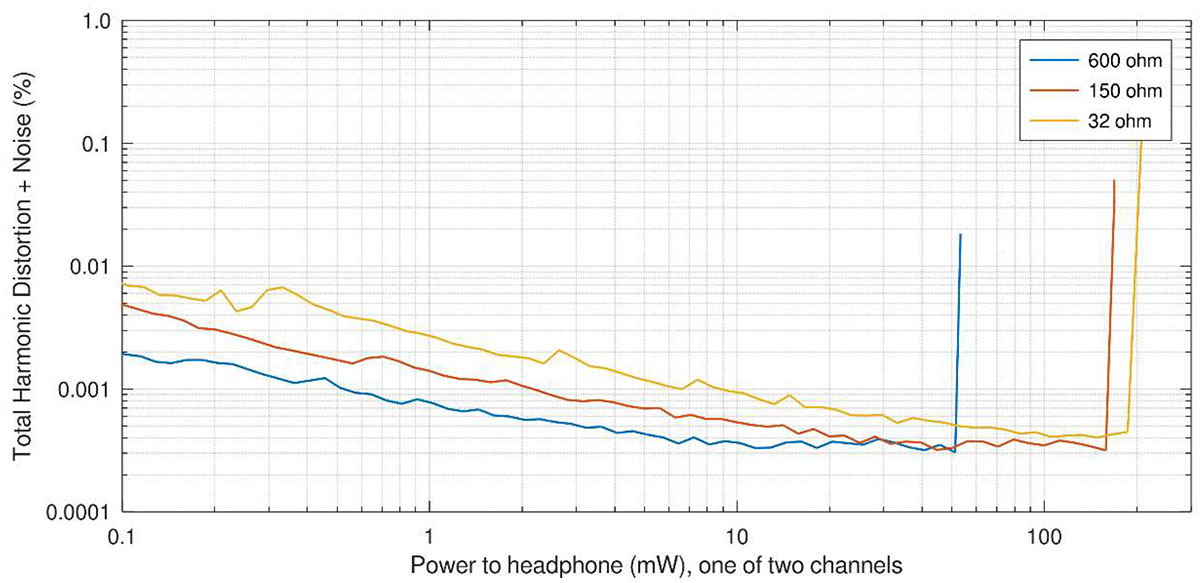 Typical total harmonic distortion + noise performance of the headphone output at various headphone imedances.